The Treasure Valley's Hidden Soil Problem: Caliche and Silt
If you live in Boise, you probably already know that our high desert climate brings intense sun and dry summers. But what many homeowners don't realize is that the soil beneath their feet is actively working against their foundation. The Treasure Valley is home to layers of caliche, a naturally cemented soil layer that forms when calcium carbonate binds together sand, gravel, and silt. Caliche behaves almost like concrete: it is hard, dense, and nearly impermeable to water. When rain or irrigation water hits a caliche layer, it cannot soak down, so it spreads sideways instead, often straight toward your foundation walls.
Mixed in with that caliche is fine silt, which behaves very differently. Silt holds water well and expands when wet, then shrinks and cracks as it dries. This constant cycle of swelling and shrinking creates Foundation Waterproofing challenges that are unique to our region. If you have noticed Meridian or Eagle homes developing stair-step cracks in the brick or gaps around windows, soil movement is often the culprit. Understanding this soil is the first step toward protecting your home.
How Irrigation Water Turns Your Soil Into a Foundation Threat
Boise homeowners love their green lawns, and keeping them lush in July means running sprinklers and drip lines almost daily. The problem is that irrigation water does not just disappear. In neighborhoods with heavy caliche, water pools on top of the hardpan and migrates along the path of least resistance, which is often the backfilled trench around your foundation. That trench was dug when your home was built, and it is usually filled with looser, more porous soil than the surrounding native ground. Water loves that loose fill, and it saturates the area right next to your basement walls.
Over time, this constant moisture creates hydrostatic pressure against the foundation. It also softens the soil under footings, leading to settling and the kind of Garden City foundation cracks that let water seep into basements and crawl spaces. Many homeowners first notice a musty smell or damp spots on the lower walls in late summer, right after a heavy watering cycle. If you are seeing these signs, it is worth scheduling a free estimate before the next rainy season arrives.
Signs of Boise Basement Leaks and Soil Movement
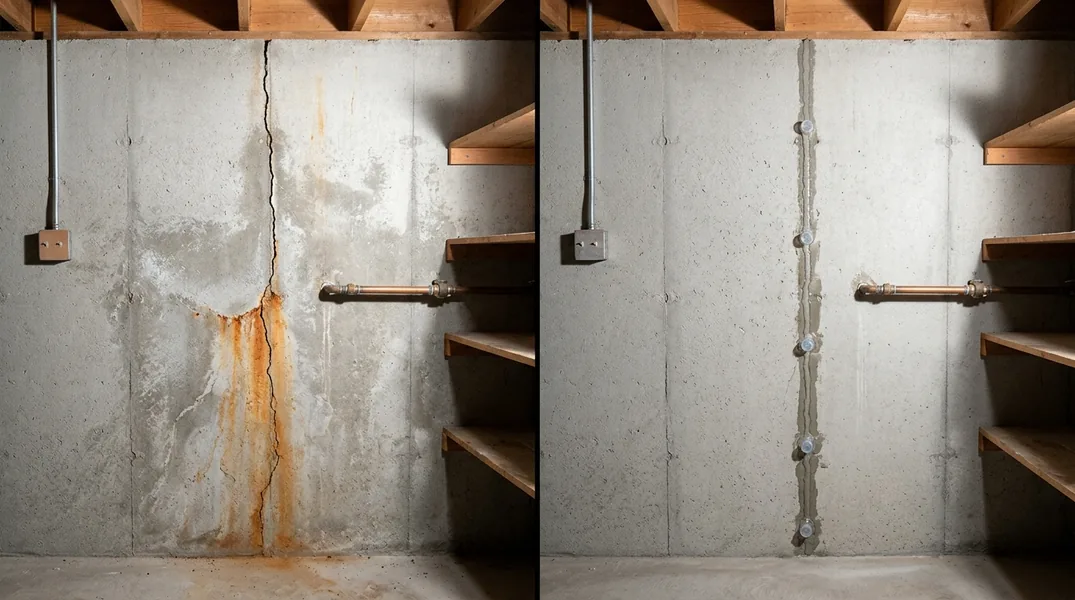
Not every basement leak announces itself with standing water. In Boise, many leaks start as efflorescence, that white chalky powder on concrete walls, or as dark damp patches near the floor line. You might notice that doors stick in the summer, or that cracks in drywall reappear after you patch them. These are classic signs of soil movement and moisture migration. Because caliche prevents proper drainage, water often collects under the slab and wicks upward, which is why some homeowners see moisture in the middle of the basement floor rather than at the walls.
It is also common to find that window wells fill with water during spring runoff, or that the ground outside the foundation stays soggy for days after rain. Left alone, these small issues compound. The expanding and contracting silt can widen existing cracks and put stress on your foundation walls. A professional assessment can tell you whether you are dealing with a simple drainage fix or a more serious structural concern, and it is far less expensive to address a small leak than a bowed wall.
Basement Waterproofing Near Me: Solutions That Work in Treasure Valley Soil
The right solution for a Boise home depends on how water is entering and what the soil is doing. For many homes, an Interior Drain Tile System is the most reliable approach. It captures water that has already made its way under the floor and routes it to a sump pump, keeping the basement dry without excavating the entire yard. This is especially effective when caliche makes exterior drainage difficult, because it manages water from the inside where it collects.
In other cases, Exterior Basement Waterproofing is the better choice, particularly if the goal is to stop water before it reaches the wall. This might involve re-grading the soil, installing exterior drainage, or applying a waterproof membrane. Many homes benefit from a combination of both approaches. A thorough inspection will identify whether the issue is hydrostatic pressure, poor grading, or a failing sump system. Every home is different, which is why a customized plan matters more than a one-size-fits-all fix.
When to Call a Boise Waterproofing Professional
Some homeowners can manage minor moisture with gutters and downspout extensions, but soil-driven water problems rarely resolve on their own. If you have tried re-grading, cleaned your gutters, and still see dampness, it is time to bring in a specialist. Boise Waterproofing serves homeowners across the Treasure Valley and understands how local soil, irrigation habits, and seasonal runoff interact. We can identify the source of the problem and recommend a solution that fits your home and budget.
If you are unsure where to start, call (208) 314-5276 to speak with a local expert. We are happy to walk you through your options and explain what a typical project looks like. You can also review our pricing page to get a sense of what to expect. Do not wait for the next heavy rain to find out your basement has a weakness. A dry basement starts with understanding your soil and taking action early.
Looking for a professional basement waterproofing contractor in Boise? Boise Waterproofing responds fast for all your basement waterproofing needs.
Get a Free QuoteOur services: Basement Waterproofing · Interior Drain Tile System · Exterior Basement Waterproofing