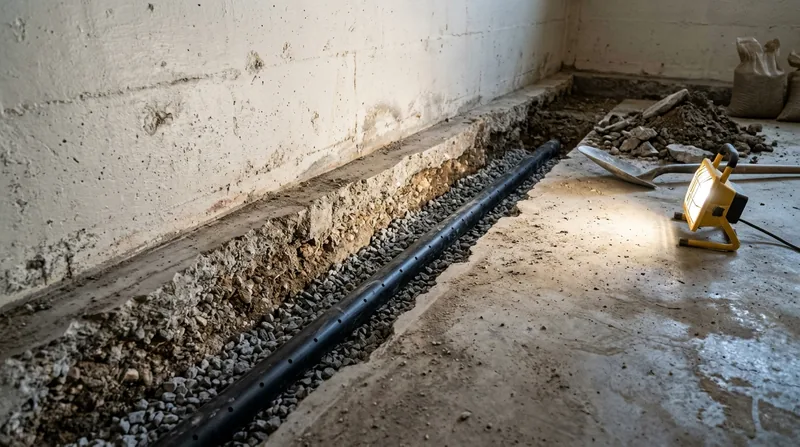




Interior Drain Tile System in Boise
An Interior Drain Tile System in Boise is the drainage solution built for this valley's specific water problem: a water table that climbs every irrigation season as canal seepage and flood-irrigated lots recharge the alluvial sand, gravel and silt under the city. Boise sits in a high-desert bowl ringed by foothills, and homes from the North End bungalows to the Harris Ranch walkouts all sit on ground that holds water differently than it drains. We cut the slab edge, capture groundwater at the footing and move it to a sump basin before it ever reaches your floor. That is the whole job, done right, in any season. If you are weighing this against other options, start with our basement waterproofing overview, then come back to this page.
Why Interior Drainage Matters in Boise's Soils and Seasons
Boise's failure mode is not coastal rain. It is hydrostatic pressure that builds when the water table rises during irrigation season and spring snowmelt, pushing against brick, stone and early poured walls in the North End, East End and Warm Springs, and against poured-concrete walls in the foothills. Cemented caliche layers under the Bench and decomposed granite in the foothills stop water from draining down, so it moves sideways into the foundation instead. In many homes a footing drain was installed decades ago and has since silted shut, which leaves the basement with nowhere to send water.
- Water seeps through the wall-floor joint because the footing drain is clogged or was never connected.
- Efflorescence and white mineral bloom appear on brick and block walls after each wet spring.
- The floor stays damp near the perimeter while the center of the slab dries out.
- Hydrostatic pressure lifts water through slab cracks and cold joints during snowmelt runoff.
- An existing sump pump runs constantly once the canals come up and the water table follows.
An interior perimeter drain relieves that pressure at the footing, where it originates, rather than trying to seal the face of a wall that water is pushing against from behind.
Key info: A 1920s North End bungalow with a stone foundation and a silted footing drain behaves nothing like a 2015 Harris Ranch walkout with a poured wall. Both can need interior drain tile, but the capture detail and sump location differ. We size the system to the wall type and the grade, not to a template.
For permit scope and inspection requirements, verify with the City of Boise Planning and Development Services before work begins, since rules vary by jurisdiction.
How We Install Interior Drain Tile in Boise Homes
We work from the inside, which means no excavation around the foundation, no disturbed landscaping and no waiting for dry weather. The sequence is deliberate: find where the water is actually entering, break out a channel at the slab edge, set the pipe at the footing, and give it a basin and a pump with somewhere to discharge. On a Bench ranch with a daylight basement, we often find the uphill wall taking the pressure while the downhill wall stays dry, and the drain layout reflects that.
- We walk the basement and map the wet zones, the wall-floor joint, slab cracks and any existing drain tile or sump.
- We break out a 12 to 16 inch channel around the interior perimeter and excavate down to the footing.
- We set perforated pipe in washed gravel with filter fabric so silt from the alluvial soil cannot clog it.
- We tie the run into a sump basin set below the slab and install a pump with a check valve on the discharge line.
- We route the discharge line to daylight or a storm-safe outlet and confirm it moves water away from the foundation.
- We backfill with gravel and cap the channel with concrete so the floor is restored and walkable.
Every system we install is finished with a transferable warranty and a clear explanation of what the drain does and does not cover.
Local example: On a 1960s split-level in Collister, the downhill side of the basement stayed dry all year while the uphill wall seeped every June. We ran interior drain tile along the uphill and side walls only, tied it to a single sump basin, and the homeowner stopped mopping the floor after irrigation season started.
If your existing system is failing rather than missing, our drain tile repair and replacement page covers what we find when a footing drain has silted shut.
Interior Drain Tile Approaches We Use
Not every wet basement needs the same system. The table below shows the main approaches we install in Boise and the conditions each one suits best. We choose based on wall type, water volume and how the home sits on the grade.
| Approach | Description | Best for |
|---|---|---|
| Full interior perimeter drain | Pipe set at the footing around all four walls, draining to one sump basin. | Basements wet on multiple walls or showing rising water table pressure. |
| Partial perimeter drain | Pipe along the wet walls only, tied to a sump basin at the low corner. | Hillside and daylight basements wet on the uphill side only. |
| Drain tile with dimple board | Drain plus a dimple board membrane on the wall to direct seepage down to the pipe. | Brick, stone and block walls that weep through the face, not just the joint. |
| Drain tile with battery backup | Standard drain and sump with a battery backup pump on the same discharge line. | Homes where a power outage during spring runoff would flood the floor. |
| Drain tile plus crack injection | Drain relieves footing pressure while active wall cracks get epoxy or polyurethane injection. | Poured walls with both joint seepage and vertical or diagonal cracks. |
We tell you plainly when simple crack sealing is enough and when hydrostatic pressure means the drain is the real answer.
Interior Drain Tile System Cost in Boise: What to Expect
Interior drain tile pricing starts from $50 per linear foot, and that figure covers the channel, pipe, gravel, filter fabric, sump basin and concrete cap. What moves the number is length of run, wall type, how deep the footing sits, and whether the discharge line has a clear route out. A short partial run on a Collister split-level costs far less than a full perimeter on a large walkout in Eagle.
Access matters too. Finished basements mean moving stored goods and protecting flooring, and older North End homes sometimes have tight stairwells and low headroom that slow the work. A sump pump replacement or battery backup added at the same time changes the total, and we price those separately so you can see what each piece costs.
Get two or three estimates and compare the scope, not just the bottom line. Ask whether the quote includes the sump basin, the pump, the discharge line and the concrete cap, because a low number that leaves those out is not a low number at all. Our full pricing overview breaks down what each component adds.
Choosing an Interior Drain Tile Contractor Near Boise
When you search for an interior drain tile contractor near me, the first thing to confirm is licensing and insurance, and then ask for the certificate rather than taking a verbal yes. A waterproofing specialist should be able to explain why interior drain tile beats exterior excavation on your particular foundation, and should tell you when a cheaper repair is the honest answer.
- Confirm the contractor is licensed and insured, and ask to see the certificate before work starts.
- Get two or three written estimates that list pipe, gravel, basin, pump and cap as separate line items.
- Ask for references from Boise, Meridian or Eagle homeowners with the same wall type as yours.
- Check with the local building department on whether your scope needs a permit, especially if the sump discharge ties into drainage or the sanitary connection.
- Ask how the discharge line will be routed so it does not dump water back against the foundation.
A contractor who walks the basement, checks the wall type and asks about irrigation season is doing the job right. Reach out through our contact page to set up a free inspection.
Interior Drain Tile System Near Me: What Boise Homeowners Should Know
Boise's water table is seasonal, and that shapes when systems fail. Most wet basements here show up in late spring and early summer as snowmelt and irrigation season push the water table up, then dry out by August. That pattern tells you the problem is groundwater pressure at the footing, not a roof leak or a plumbing drip, and it is exactly what interior drain tile is built to handle.
Freeze-thaw winters matter too. Water that sits against a foundation in January opens cracks, and the alluvial silt around a footing drain slowly fills the pipe until it stops working. We install in any season, and winter is often the easiest time to get on the schedule. For homes in Garden City and the North End, our Boise 83702 service page covers the older housing stock in more detail.
If you are already seeing water in the basement, do not wait for the next irrigation season. Call (208) 314-5276 and we will tell you what the drain will and will not solve.
Interior Drain Tile System in Boise: Pricing Guide
| Service | Price | Details |
|---|---|---|
| Partial perimeter drain tile | Starting at $50/linear ft | Covers channel, perforated pipe, washed gravel, filter fabric and concrete cap on wet walls only. |
| Full perimeter drain tile with sump basin | Starting at $65/linear ft | Adds a full four-wall run plus sump basin, pump and check valve on the discharge line. |
| Drain tile with dimple board and wall membrane | Starting at $80/linear ft | Adds dimple board on brick, stone or block walls that weep through the face. |
| Drain tile with battery backup pump | On estimate | Priced after we confirm discharge route and backup capacity needed for spring runoff. |
| Travel | Included | In Boise and surrounding areas, no separate call-out or mileage fee. |
| Estimate | Free | Response within 24h at (208) 314-5276, no obligation to book. |
Indicative pricing, the exact cost depends on square footage, finish, and site access. Free personalized estimate within 24h at (208) 314-5276.


